

Why Leggings Are Never “Just a Basic Product” in the US Market
Anyone outside the apparel industry often assumes leggings are simple. They stretch, they’re black, and they sell well—how hard could they be?
But anyone who has actually tried to build a leggings line for the US market knows the truth: leggings are one of the most unforgiving products a brand can manufacture. A hoodie can hide small mistakes. A T-shirt can survive minor tolerance issues. Leggings cannot.
From a China-based garment manufacturer working with B2B clients in the United States and other developed markets, we’ve seen this reality play out repeatedly. Leggings sit right against the body. Customers feel every flaw. If the waistband rolls, if the fabric turns sheer when squatting, or if the fit changes between colors, your customer doesn’t think about production challenges—they simply don’t reorder.
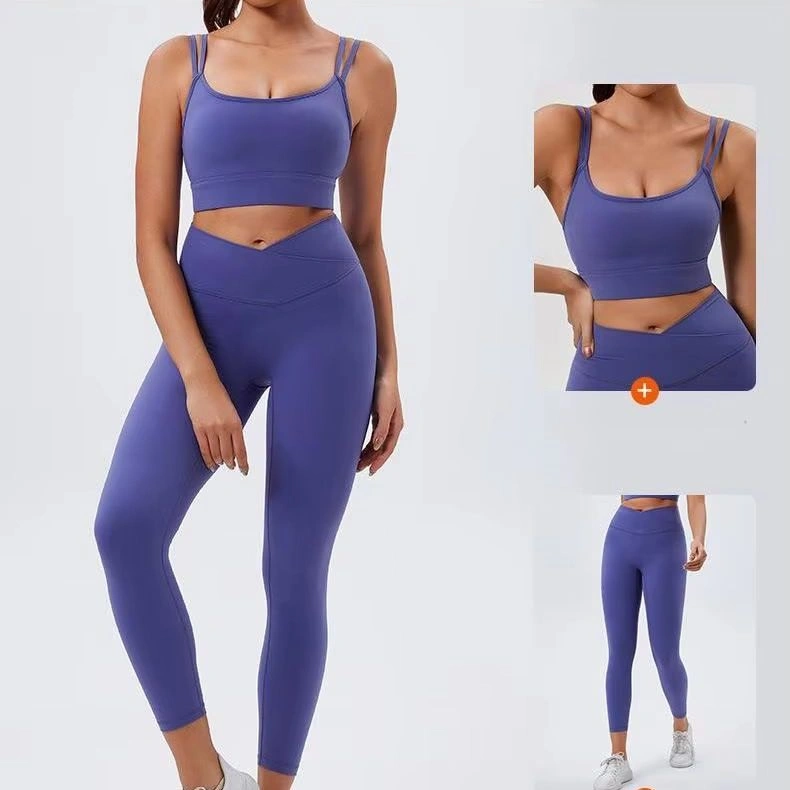
That’s why leggings often determine whether a brand builds loyalty or burns trust.
This article is written for brand owners, sourcing managers, and private label buyers who are seriously evaluating bulk and OEM legging production. It’s not based on theory or marketing language. It reflects real manufacturing experience, real buyer pain points, and the practical decisions that separate successful programs from expensive mistakes.
How US and Developed-Market Buyers Actually Think When Sourcing Leggings
When US buyers search for a legging manufacturer, they’re rarely at the “idea stage.” Most are already under pressure.
They may be replacing a supplier who failed them. They may be preparing for a major reorder and can’t afford inconsistency. Or they may be launching a brand and know that leggings will define how customers judge them.
Who This Article Is Really For
This content is written for:
- US activewear and athleisure brands building long-term collections
- Private label companies supplying retailers or online channels
- Direct-to-consumer brands preparing to scale beyond small batches
- Importers and distributors who need stable, repeatable SKUs
- Fitness studios or corporate buyers ordering bulk branded leggings
Across all these groups, one thing is consistent: nobody wants to experiment recklessly. Inventory mistakes are expensive, and leggings magnify those mistakes quickly.
What Buyers Truly Care About (Beyond Price)
From years of working with US and developed-market clients, buyer priorities tend to line up like this:
- First, fit consistency. Customers notice immediately when leggings fit differently between sizes or reorders.
- Second, fabric performance. Stretch recovery, opacity, and durability matter far more than fabric buzzwords.
- Third, predictability. Brands don’t just want one good shipment—they want the next five to be the same.
- Fourth, total cost, not unit price. Returns, defects, and rushed air freight destroy margins faster than a slightly higher FOB price.
- And finally, professional private label execution. Labels, care instructions, packaging, and compliance must be correct for the US market.
Any manufacturer who understands these priorities immediately stands apart.
Why China Still Plays a Central Role in Legging Manufacturing
China remains one of the most important production bases for leggings worldwide—not because of “cheap labor,” but because of infrastructure that has been built and refined over decades.
As a custom legging manufacturer in China, the advantage we offer to US and developed-market buyers is systemized production. Leggings require control, and control requires mature supply chains.
What China Offers That’s Hard to Replicate
China provides:
- Deep textile ecosystems with consistent material availability
- Advanced knitting, dyeing, and finishing facilities
- Specialized experience in seamless and compression garments
- Capacity that supports both growth and repeatability
Leggings demand tight control over stretch, recovery, opacity, and color stability. Those qualities don’t come from inspection alone—they come from experience, process, and integrated supply chains.
A professional legging manufacturer understands that quality is something you design into the product, not something you try to “check” at the end.
Seamless vs Cut-and-Sew: A Practical View, Not a Trend-Driven One
Many buyers come in convinced they need seamless leggings. Others assume cut-and-sew is outdated. In reality, both methods serve different purposes, and choosing the wrong one often leads to disappointment.
Seamless Leggings: Where They Shine—and Where They Don’t
A seamless legging manufacturer uses circular knitting machines to produce garments with minimal seams. When done correctly, this creates:
- Smooth, body-contouring compression
- Reduced friction during movement
- A clean, modern aesthetic popular in yoga and studio wear
For yoga and performance brands, seamless leggings can feel incredible when engineered properly.
But seamless production also requires strict control. Yarn quality, knitting programs, and dyeing processes must be stable. Without that, compression becomes uneven, sizing drifts, and garments distort after washing. Seamless does not automatically mean premium—it only becomes premium when managed correctly.
Why Cut-and-Sew Is Still Widely Used
Cut-and-sew leggings remain extremely important, especially for:
A specialized cotton legging manufacturer often relies on cut-and-sew to maintain softness, breathability, and predictable fit. For many US private label buyers, cut-and-sew also allows faster development and more design flexibility during early launches.
The best decision isn’t about trends—it’s about matching construction to the product’s purpose.
Fabric Selection: Where Most Legging Programs Succeed or Fail
If there’s one area where mistakes are hardest to recover from, it’s fabric selection. Fabric determines not only how leggings feel, but how they perform months later.
What US Buyers Expect From Legging Fabrics
US and developed-market buyers expect fabrics that:
- Remain opaque under stretch
- Recover after wear instead of bagging out
- Feel soft without becoming fragile
- Resist pilling and deformation
Simply stating “nylon/spandex” or “poly/spandex” is not enough. A serious best legging manufacturer focuses on how the fabric behaves, not just what it’s made of.
Common Fabric Categories in Bulk Production
Performance-focused brands often choose nylon/spandex blends for their balance of strength and softness. Polyester/spandex blends are common for durability and cost control. Cotton/spandex blends work well for lifestyle and lounge wear. Sustainable or recycled fibers are increasingly important for brands with environmental positioning.
An experienced best legging manufacturer in China helps buyers select fabrics based on brand positioning, target pricing, and how customers will actually use the product—not just what sounds good in a spec sheet.
Compression: Where Manufacturing Experience Really Shows
Compression is often misunderstood. It’s not about making leggings tighter. True compression supports the body without restricting movement or comfort.
A professional china compression seamless legging manufacturer controls compression through yarn selection, knit structure or panel placement, waistband engineering, and defined stretch-recovery targets.
This level of control doesn’t come from guessing. It comes from technical knowledge built over many production cycles. Factories without that experience may produce samples that feel fine initially but fail after real-world wear.
This is where expert-level manufacturing knowledge becomes visible—and where long-term brand success is decided.
Fit Consistency: The Quiet Factor That Drives Profit or Loss
Fit inconsistency is one of the fastest ways to damage a legging program. Customers may tolerate small cosmetic issues, but they will not tolerate leggings that fit differently each time they order.
What Consistent Fit Actually Requires
A reliable custom legging manufacturer serving US buyers must:
- Build size blocks aligned with US body standards
- Apply consistent grading logic
- Control measurement tolerances carefully
- Test fit through movement, not just static fitting
When these steps are followed, leggings fit the same way across colors, batches, and reorders. That consistency is essential for wholesale and private label programs.
MOQ Strategy: Helping brands grow without taking on too much risk
Minimum order quantities are just a normal part of how things are made. They aren’t going anywhere. But you can avoid using MOQ as a hard wall that stops brands from growing too quickly.
Many US clothing brands work with a custom leggings maker in China because the minimum order quantities (MOQs) are often more in line with how brands actually grow. Early orders are mostly about testing fit, checking how the fabric works, and seeing how customers react. As sales level off and demand becomes more predictable, the number of orders naturally goes up and the cost per unit goes down.
Brands can carefully enter the market with this level of flexibility while still meeting professional production standards. Options like color-based MOQs help keep inventory levels low, especially when brands are trying out new seasonal colors or adding to an existing range. When you use MOQ strategically, it stops being a limit and starts being a planning tool that helps your business grow steadily without hurting the quality of your products or the efficiency of your factories.
Quality Control and Compliance: Things That Can’t Be Changed in the US Market
Quality control is not optional for US buyers; it is a must. Quality problems don’t just lead to returns. They hurt the credibility of the brand, make it harder to work with retailers, and in some cases make it harder to follow the rules, which can be hard to fix.
Quality control doesn’t happen at the end of the line when making professional leggings. It is a part of every step of the production process. Before cutting or knitting starts, fabric is checked for flaws. This is because flaws that are found early on tend to get worse later on. In-process checks during sewing or seamless production help find problems with sizing or construction before they get too big to fix.
Before shipping, measurements are checked against approved samples, and final inspections are done using AQL standards that are widely used. We also pay close attention to labeling and care instructions, especially for private label orders where accuracy and following the rules are very important for the brand. There is no room for shortcuts at this level; every detail is important.
Cost Performance: Why the Lowest Bid Is Often the Most Expensive Option
People who have bought things before learn this quickly: the lowest unit price is not usually the best deal overall.
The first quote doesn’t show true cost efficiency; it shows up over time. You can see it in fewer defects, fewer shipments that are turned down, and smoother production cycles. It’s the difference between predictable restocking and emergency air freight that quietly eats into profits. It also shows up in fewer resampling rounds and less back-and-forth during production. These costs don’t always show up on paper, but they add up quickly.
This is why a lot of US brands stick with the same leggings maker once they find one they can trust. Consistency makes things run more smoothly. That stability protects margins much better over several seasons than trying to get small price differences between factories.
Long-Term Brand Investment in Private Label Leggings
You shouldn’t think of private label leggings as things that will only last a short time. They are an important part of a brand.
Leggings are often one of the most reliable types of clothing that a brand makes when they are made correctly. Customers trust you more when your clothes fit well every time. Restocking on time stops sales from being lost. Over time, careful customization—like how the waistband is made, the branding details, or the packaging—makes the brand more recognizable.
A professional yoga leggings maker knows that making new products doesn’t end after the first big order. Feedback is what really helps you get better. This includes how the leggings feel, how they wash, and what customers say after using them for months. That feedback helps make small changes that slowly change a basic style into a core product that customers know and buy again.
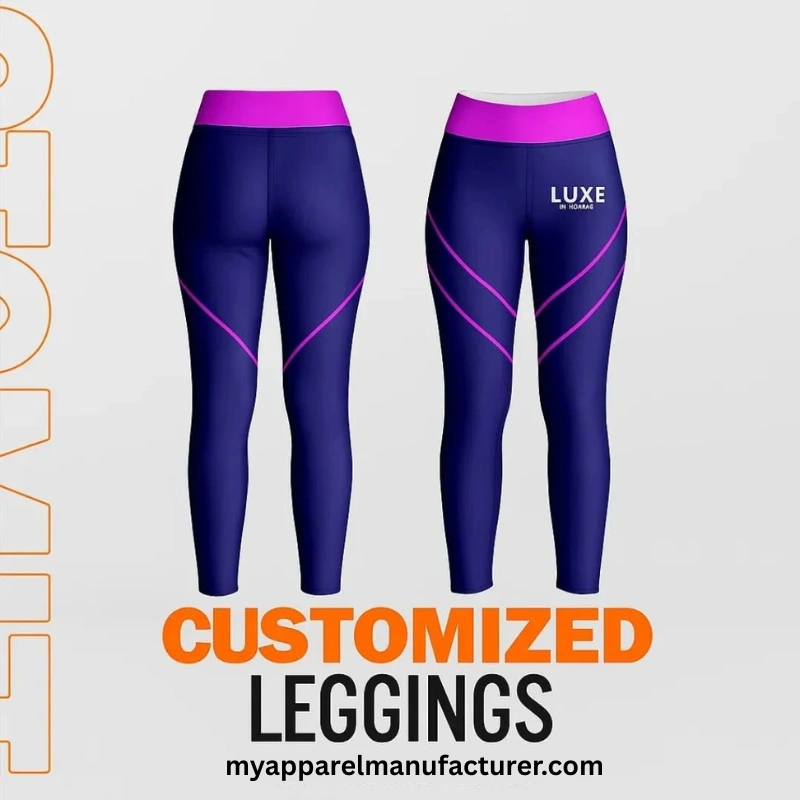
How MYAPPARELMANUFACTURER.COM Meets the Needs of B2B Buyers
From a B2B sourcing point of view, platforms like MYAPPARELMANUFACTURER.COM appeal to buyers in the US and other developed markets because they are clearly focused on OEM and private label manufacturing rather than direct-to-consumer retail.
That difference is important. People who buy a lot of leggings aren’t looking for marketplaces or ready-made items. They want manufacturing partners who know how to work with large numbers of people, do things over and over, and work together for a long time. Professional buyers look for suppliers who have clear OEM workflows, defined use cases for brands and wholesalers, and production systems that are made to help the business grow.
In real life, the positioning shows how serious sourcing decisions are really made.
Conclusion: How to Choose the Best Bulk Custom Leggings Manufacturer
Leggings are still one of the most competitive and technically difficult types of clothing to sell in the US. To be successful, you need to be precise, have strict production processes, and know what buyers want.
From the point of view of a clothing maker in China that sells to businesses in the US and other developed markets, the pattern is the same. Brands that see manufacturing as a long-term partnership instead of a one-time deal do better over time. They have fewer problems, more loyal customers, and more stable margins.
A brand’s choice of leggings manufacturer, whether it’s a seamless leggings maker, a cotton leggings maker, or weighing domestic production against overseas options, comes down to reliability. Long-term value, performance, and consistency are much more important than saving money in the short term.
More information: The future of the B2B leggings market
The leggings market is always changing, but we know where it’s going. The field of compression engineering is getting better. Sustainable materials are no longer just nice to have; they’re now expected. Brands want more flexibility without giving up quality, and the time it takes to restock is getting shorter.
MOQ flexibility and more collaboration with OEMs are no longer things that set you apart; they’re becoming the norm. It’s not just a matter of finding a leggings manufacturer in China that knows how to work with US brands and private label buyers anymore. It is a strategic choice that has a direct impact on how competitive you are.