


Introduction
OEM vs Custom Clothing Manufacturing Guide for Startups: Discover the pros, costs, and best strategy to launch your clothing brand successfully.
One of the first actual decisions that a new clothing brand has to make isn’t necessarily about fonts, logos, or Instagram style. It’s something a little more fundamental that has to do with your bottom line, your schedule, your product quality, and your ability to get to market quickly. Do you OEM, or do you design your own products from scratch?
They both work. They’ve both been used to create successful clothing companies. They’ve both been used to create costly failures, depending on the decision that the clothing brand founder made, depending on which route they went, and whether or not that route was appropriate for that brand.
This guide isn’t necessarily going to tell you which one is better, because the truth is, neither one is. What I can do is give you a look at what each one entails, and what you should think about in terms of whether or not one of these routes is appropriate for you.

First, Let’s Be Clear on What These Terms Actually Mean
Before going further, it helps to be precise — because these terms get used loosely in the industry.
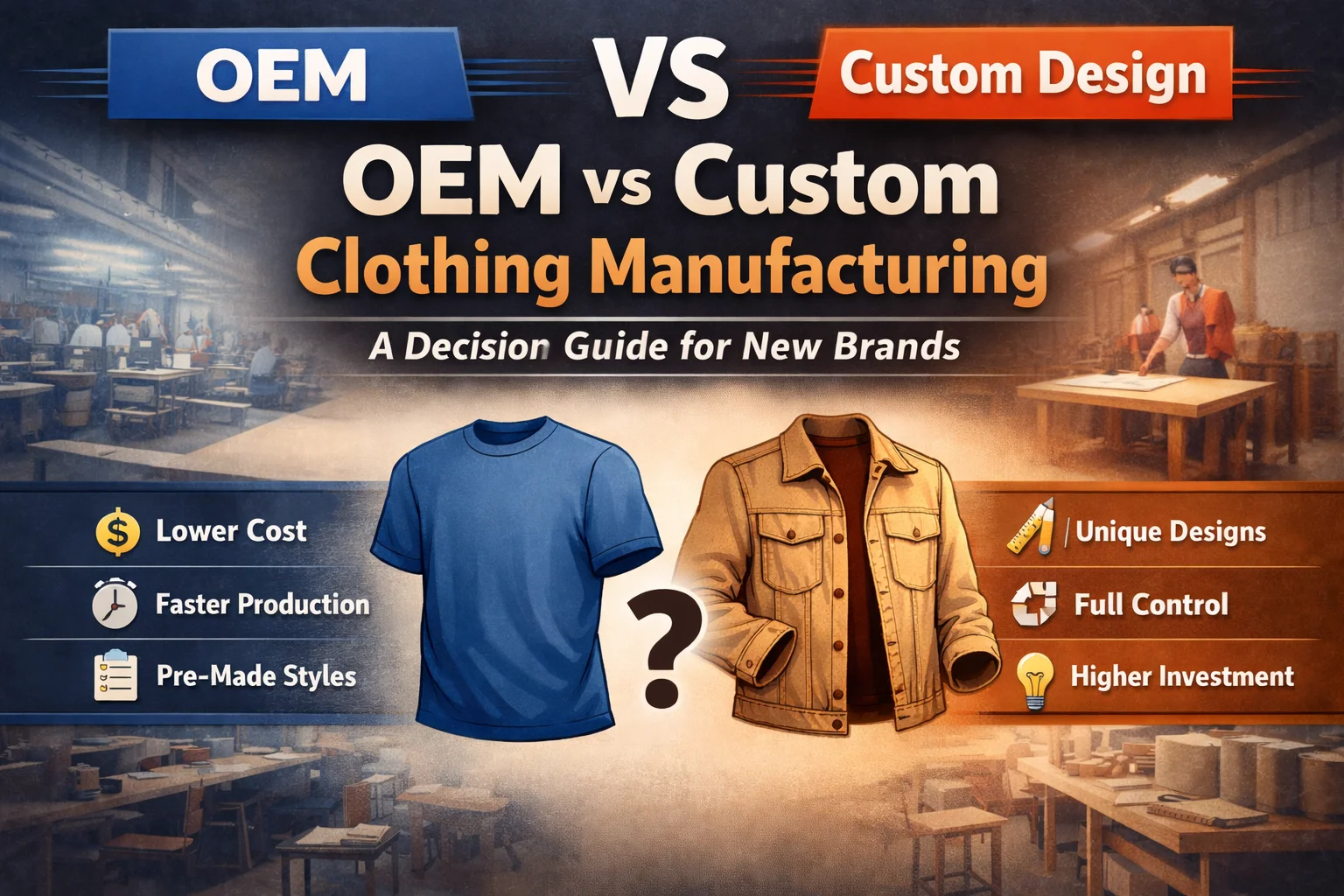
OEM (Original Equipment Manufacturing) in the apparel context means the factory produces garments using their existing blocks, patterns, and construction methods. You select from what they can make, customize details like fabric, color, and fit adjustments within certain parameters, and brand the product as your own. The manufacturing infrastructure — patterns, grading, construction specs — already exists.
“Custom/Design Your Own” means that you provide your own designs, tech packs, and specs to the factory. They make what you want. They make the patterns from scratch to match your designs. You have complete control over all aspects of the garment: shape, construction, fabrics, fit, hardware, etc. In reality, there’s a range between these two extremes. Some brands begin with OEM and gradually incorporate “custom” features. Some brands have their own designs but use factory-standard construction to keep costs under control. For this discussion, we’re focusing on the extremes because the logic for making a particular choice is clear at those points.

The Case for Starting with OEM
Lower Upfront Investment
The single biggest practical advantage of starting with OEM is cost. When patterns already exist, you’re not paying for pattern making. When the factory has produced that silhouette hundreds of times, sampling is faster and cheaper. When construction methods are standardized, production runs more efficiently.
For a new brand with limited capital, this matters enormously. The money you save on development can go toward inventory depth, marketing, or simply reducing the financial risk of your first production run.
Faster Time to Market
A custom clothing line requires rounds of sampling, fit corrections, and spec refinement before you’re ready for bulk. That process typically takes months. OEM, with its established patterns and production methods, compresses the timeline significantly.
If you’re trying to hit a specific retail window, a seasonal trend, or a launch date tied to a marketing campaign, OEM’s speed advantage is real.
Lower Technical Barrier
Designing a garment from scratch requires technical knowledge — or someone on your team who has it. A proper tech pack includes construction details, measurement specs, grading increments, seam allowances, and material specifications. Getting this wrong at the design stage cascades into problems at sampling, which cascade into problems at bulk.
OEM sidesteps most of this. The factory already knows how to build the product. Your job is to customize and brand it, not to engineer it. For founders with backgrounds in marketing, retail, or business rather than fashion design or technical production, this is a significant advantage.
Easier to Test the Market
Before you invest heavily in a custom product line, it helps to validate that your market actually wants what you’re selling. OEM lets you launch faster and cheaper — which means you can test customer response, refine your positioning, and learn what’s working before making larger bets.
Many successful brands started OEM specifically because it allowed them to build an audience and generate revenue while they developed their custom line in the background.

The Limitations of OEM
Your Product Isn’t Truly Unique
This is the most honest limitation of OEM, and it matters more in some markets than others.
If the factory offers that same silhouette to other brands — which they often do — your product’s differentiation comes entirely from branding, marketing, and positioning rather than the product itself. In commodity categories like basic tees or standard hoodies, this can work. In markets where product differentiation matters deeply, it’s a real weakness.
Limited Control Over Fit and Construction
OEM patterns are designed to work for a general market. If your brand has a specific fit philosophy — a particular rise on a trouser, a specific chest width ratio, a silhouette that doesn’t exist in standard blocks — OEM can’t get you there. You’re working within the factory’s existing architecture, not building your own.
Harder to Build a Defensible Brand Long-Term
The brands that command premium pricing and loyal customers over time generally do so because of their product — its quality, its fit, its design. A brand built entirely on OEM products with standard construction and widely available silhouettes can be harder to differentiate at scale.
This doesn’t mean OEM brands can’t succeed long-term. But the most ambitious brand-building strategies eventually require a product that only you make.
The Case for Designing Your Own
Complete Creative and Technical Control
As the designer of your own product, you get to decide everything. Everything. Shape, construction, fabric, hardware, fit, finish. None of it is dictated to you in terms of some other brand’s standard template.
For apparel companies that are, in fact, defined by their products, where the product itself is meant to stand out, innovate, or even define its category, this is not just a choice. This is the entire point.
Your Product Is Yours
A product made to your own specifications, your own technology, your own patterns, and your own design is proprietary. No other brand can replicate your product, even if they go to the same factory and order the same option in the same catalog.
But that’s not even close to being the end of the story. As your brand continues to mature, your fit becomes your signature. Your construction details become your signature. That’s how you build equity in your product.
More Appropriate for Premium and Niche Positioning
If you’re entering a category where your customers are discerning, where they care about the technology, the craftsmanship, and the overall design of your product, they’ll know if you’ve designed your product or if you’ve assembled your product out of standard parts.

The Limitations of Designing Your Own
It Costs More, in Time and Money
Custom product development is costly. Pattern making, sampling, fitting, and specification changes add up before you’ve made a single sellable product. It takes longer, too. The cost and time required for custom product development, if you want to get it right, can take anywhere from three to six months, or longer, to get to a production-ready sample.
For a bootstrapped brand, it can be a high cost, and for a brand that has tight deadlines, it can be a showstopper.
It Requires Technical Knowledge
What you need is a tech pack. And it’s got to be accurate. If you don’t have the knowledge to do that yourself, you’ll need to find someone who does, a pattern maker, a technical designer, or a product development consultant.
Bad tech packs mean bad samples. Bad samples mean multiple revision cycles. And that means that development takes longer, and it ends up costing more. The accuracy of the technical information in your design documents has a direct impact on everything that follows.
Higher Stakes if the Product Doesn’t Work
When you’ve invested heavily in creating a custom product, and then you find that the market doesn’t want it, or the fit isn’t right, or the price point isn’t feasible, there’s more at stake than with OEM.
OEM allows you to fail cheaply. Custom design means the cost of a wrong guess is higher.
How to Actually Make the Decision
Here are the questions that cut through the noise:
What is your budget for development?
If you’re launching with limited capital and need to protect your runway, OEM’s lower development costs are hard to ignore. If you have real investment behind you, custom development is more viable.
How important is product differentiation to your brand strategy?
If your brand’s value proposition lives in the marketing, the community, the story — and the product is a vehicle for that — OEM may serve you well. If the product itself is meant to be the differentiator, custom is necessary.
What is your technical capability?
Do you have the design and production knowledge to brief a factory effectively on custom product? If not, do you have the budget to hire someone who does? If the answer to both is no, OEM is the more realistic starting point.
How quickly do you need to launch?
Custom development takes time. If your window is tight, OEM gives you a better chance of hitting your timeline.
What category are you entering?
Basic casualwear, branded merchandise, and gift-adjacent apparel can work well at OEM. Technical performance gear, premium fashion, and category-defining product almost always requires custom.
Are you testing or committing?
If this is a market validation exercise — you want to see if there’s demand before going deep — OEM is the lower-risk test. If you’re committed to building a serious brand over years, the earlier you develop a proprietary product, the better.
The Hybrid Approach Most Successful Brands Actually Use
Here’s what a lot of experienced founders eventually land on: start with OEM or near-OEM to get to market, generate revenue, and build an audience. Then reinvest in developing a custom product over time as you learn what your customers actually want.
This isn’t a compromise — it’s a sensible sequencing strategy. You’re not stuck with OEM forever because you started there. And you’re not betting everything on a fully custom line before you know whether the market is there.
Many of the brands that look like they launched with a fully original product line actually refined their product significantly over the first twelve to twenty-four months. What you see at their Year 3 is not what they launched with at Month 1.
Working with My Apparel Manufacturer
At My Apparel Manufacturer, we support both paths — and everything in between.
For brands starting with OEM or near-OEM, we offer low MOQ production, fabric sourcing, custom labeling and packaging, and fast sampling so you can get to market without overextending your budget.
For brands ready to develop custom product from scratch, our team can work from your tech packs, assist with pattern development, and guide you through a sampling process designed to get your garment right before bulk production begins.
We work with brands across the USA, UK, Europe, and Australia — from founders placing their first order to established labels managing multi-season production. Wherever you are in the process, we can meet you there.